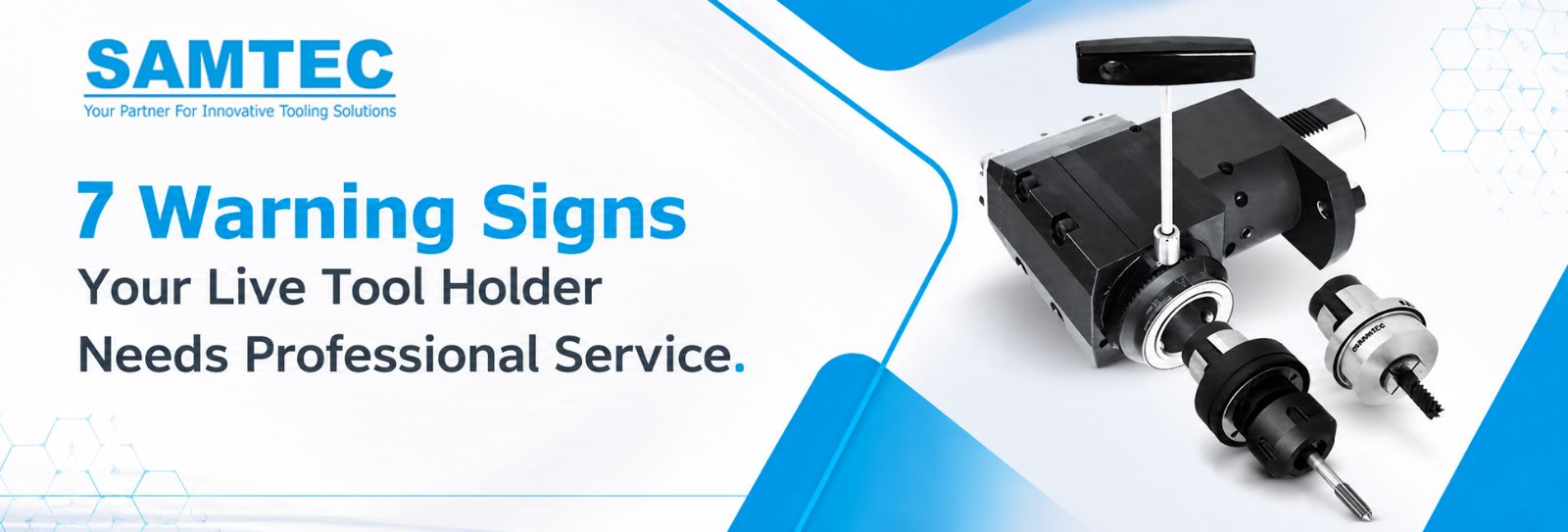
In modern CNC machining, live tool holders play a crucial role in achieving high-speed, high-precision milling, drilling, and tapping operations. These tools are built to withstand demanding production environments, but continuous operation eventually leads to wear and performance issues.
Ignoring early warning signs can result in poor machining accuracy, unexpected downtime, expensive repairs, and even machine spindle damage. Regular inspection and professional servicing can significantly extend the life of your live tool holders while maintaining production efficiency. Samtec Tools specializes in repairing and rebuilding live tooling across a wide range of brands, helping manufacturers restore performance at a fraction of replacement cost.
1. Excessive Vibration During Machining
One of the earliest signs of a failing live tool holder is abnormal vibration.
If your machine suddenly begins producing unusual vibrations during drilling or milling operations, internal bearings, worn gears, or spindle components may be deteriorating.
Effects include:
• Poor surface finish
• Reduced dimensional accuracy
• Increased tool wear
• Higher stress on the machine spindle
Professional servicing helps identify the root cause before it leads to major failures.
2. Unusual Noise While Operating
Healthy live tool holders operate smoothly and quietly.
If you hear:
• Grinding sounds
• Clicking noises
• Metal-to-metal contact
• High-pitched whining
these symptoms often indicate damaged bearings, insufficient lubrication, or internal gear wear.
Ignoring these sounds may eventually lead to complete tool failure.
3. Poor Machining Accuracy
Have you noticed parts falling outside tolerance?
When a live tool holder develops excessive runout or internal wear, machining precision begins to suffer.
Common symptoms include:
• Inconsistent hole sizes
• Misaligned features
• Poor concentricity
• Repeatability issues
Professional calibration and rebuilding restore machining accuracy.
4. Tool Holder Overheating
Heat is one of the biggest enemies of precision tooling.
A live tool holder that becomes unusually hot during operation may indicate:
• Bearing failure
• Lack of lubrication
• Internal friction
• Misalignment
Operating an overheated tool holder for extended periods can permanently damage internal components.
5. Visible Oil Leakage
Oil leakage should never be ignored.
If lubricant begins leaking around the spindle or seals, internal contamination becomes likely.
Leaking oil can result in:
• Premature bearing failure
• Increased friction
• Component corrosion
• Reduced service life
Replacing seals and servicing the lubrication system early prevents more expensive repairs.
6. Reduced Cutting Performance
If machining cycles suddenly become slower or cutting performance declines despite using new cutting tools, the issue may not be the cutter—it could be the live tool holder.
Symptoms include:
• Increased cutting force
• Poor chip evacuation
• Reduced spindle efficiency
• Lower productivity
Professional inspection can restore the tool holder to optimal operating condition.
7. Frequent Tool Breakage
Unexpected tool breakage is often a hidden sign of live tool holder problems.
When internal runout increases or spindle alignment shifts, cutting loads become uneven, causing expensive cutting tools to fail prematurely.
Instead of repeatedly replacing cutting tools, have the live tool holder inspected by experienced technicians.
Why Professional Live Tool Holder Service Matters
Regular maintenance offers several long-term advantages:
• Extends equipment life
• Reduces unexpected downtime
• Restores machining accuracy
• Improves productivity
• Saves replacement costs
• Protects expensive CNC machine spindles
At Samtec Tools & Accessories Pvt. Ltd., experienced technicians repair and rebuild live tooling for virtually every major brand using precision inspection, calibration, bearing replacement, seal replacement, testing, and quality control processes. Their repair workflow is designed to restore performance while minimizing production downtime.
Conclusion
Your live tool holder is a precision component that directly impacts machining quality, production speed, and overall manufacturing costs. Recognizing these seven warning signs early can prevent costly machine breakdowns and extend the life of your equipment.
Instead of waiting for complete failure, schedule a professional inspection and servicing to keep your CNC operations running efficiently.